Indicadores de actividad de I+D+i

¡Cuidado con los indicadores! En el seguimiento y evaluación de la investigación académica e institucional y de su impacto, los indicadores son un arma de doble filo. En este contexto, los indicadores de desempeño (key performance indicators – KPI en inglés) reducen actividades y fenómenos complejos a valores fáciles de medir y reportar. Esta simplificación puede ocultar matices importantes incluidos en los objetivos, pero no en los KPI elegidos para su seguimiento. Esto ocurre porque en estos contextos no se puede escapar de objetivos fundamentalmente cualitativos, relacionados con el gran objetivo general de «aumentar el impacto de las actividades de I+D». Los KPI cuantitativos están disponibles, y son tentadores. Son fáciles de usar y comparar, por ejemplo publicaciones en revistas de alto impacto, fondos públicos recibidos, número de patentes licenciadas… ¿Qué podemos hacer? En la medida de lo posible, buscar fuentes de información para un equilibrio entre distintos tipos de KPI. Diseñar un panel de control que combine métricas cuantitativas con otras cualitativas.

No será un panel de control fácil de completar e interpretar, pero para moldear nuestra estrategia puede ser crítico incorporar KPI cualitativos, para tener un seguimiento y evaluación más acertados.

Una segunda precaución tiene que ver con aligerar y priorizar. Buscar y generar KPI bien alineados con los objetivos, y no dar el mismo peso a otros indicadores no bien relacionados con el seguimiento buscado, aunque sean fáciles de recoger.

Algunos ejemplos de uso de KPI en el entorno académico:

El sistema REF (Research Excellence Framework) de evaluación de la actividad de investigación de instituciones superiores en el Reino Unido. Es un sistema con una metodología basada en la evaluación de producción, impacto y entorno. Más información sobre qué incluye cada uno de estos apartado y qué peso tienen, aquí y aquí. El REF emplea una variedad grande de métricas de evaluación, y es significativo que una parte son casos de impacto presentados con evidencia narrativa. Además el sistema se basa en la evaluación por pares para la valoración y clasificación de los resultado de cada indicador en varios niveles de importancia, lo que influye mucho en su peso en el resultado final. Es muy interesante estudiar cómo se presentan los casos de impacto y analizar qué incluyen los casos con una valoración máxima en el REF, por ejemplo estos casos. Se pueden consultar todos los del REF 2021en esta base de datos de la universidad de Cambridge.

Indicadores de seguimiento de la estrategia de investigación de la Universidad de Glasgow. Las universidades en el Reino Unido dependen mucho de sus resultados en el REF para recibir más o menos fondos del sistema público. El objetivo central de sus estrategias es mejorar la clasificación en el REF. La estrategia de la universidad de Glasgow es llamativa por haber conseguido esto con mucho éxito (posición #24 global REF 2014 a #6 en el REF 2021) centrada en unos pocos y seleccionados objetivos: talento y colaboración. De manera mantenida desde hace más de una década esta universidad tiene una variedad de acciones relacionadas con la atracción y retención de talento y con el apoyo a la colaboración interna y la internacionalización como estrategia principal de mejora de su actividad de I+D+i. En relación a cómo se hace el seguimiento de esta estrategia con indicadores, además del propio REF, es interesante la variedad y selección de KPI que emplean. Un panel corto y ligero que combina KPI de actividad general de la universidad con otros muy específicos relacionados con los programas internos que apoyan la estrategia.

Mas sobre indicadores en el entorno de la I+D académica: KPI recogidos por la Comisión Europea relacionados con I+D+i a nivel de EU: https://research-and-innovation.ec.europa.eu/statistics/performance-indicators_en

Una buena entrevista de trabajo

En el mundo corporativo, y parece ser que también en algunas instituciones públicas académicas, las entrevistas de trabajo están estructuradas a menudo con el método STAR. Se basan en preguntas sobre el carácter de un candidato, sobre su comportamiento frente a situaciones profesionales. Las respuestas son a priori fáciles de puntuar y de comparar de manera uniforme entre candidatos, lo que resulta atractivo para realizar un proceso de selección consistente y con apariencia de objetividad. Sin embargo hay un problema grande con este tipo de entrevistas. Muchos de los candidatos han ensayado y preparado las respuestas, porque las listas de preguntas y cómo prepararlas son bien conocidas.

Al hacer la entrevista es algo evidente si un candidato ha preparado este tipo de preguntas. Por otra parte si como candidato eres entrevistado con este método, sin más oportunidades de interacción con el entrevistador, demuestra una falta de preparación de la entrevista que en mi opinión es una mala señal, una «red flag» sobre el futuro lugar de trabajo. Este tipo de entrevista se convierte en buena parte en un filtro de candidatos que han preparado la entrevista frente a los que no. Puede parecer que no es tampoco un mal resultado, pero creo que no es un filtro particularmente útil. Las razones para haber preparado o no una entrevista pueden ser difíciles de evaluar. Alguien que no ha preparado la entrevista demuestra a priori poca disciplina de trabajo o ser un novato de los procesos de selección. Por otro lado alguien que sí sabe responder las preguntas STAR con rapidez es posible que haya hecho ya muchas entrevistas.

En conclusión, si buscamos seleccionar al mejor candidato para nuestro equipo, hay que dedicar un tiempo a pensar en cómo hacemos la entrevista y cuales son las características del candidato que buscamos. El método STAR puede ser una parte de la entrevista, que debe ser además flexible dependiendo de la interacción con el candidato. Hay que conseguir información sobre rasgos de personalidad, y STAR es a priori bueno para esto, pero puede fallar estrepitosamente por ser demasiado estructurado y previsible para los candidatos. El riesgo es que se valore más la habilidad de contar una historia ensayada que la competencia técnica, la capacidad de razonar y adaptarse en entornos cambiantes, o la de hacer las cosas bien cuando nadie mira. Un método conversacional puede ser mejor si la persona que realiza la entrevista es buena con este método.

Para completar el tema de este post sobre de qué hablar en una buena entrevista de trabajo, creo que además de los rasgos de personalidad hay otra cualidad profesional que es necesario descubrir al máximo en un proceso de selección: el conocimiento científico y técnico general y la capacidad de adquirir nuevo conocimiento. Creo que no se le da la importancia que tiene a nivel transversal. Esta claro que muchos trabajos necesitan de conocimientos técnicos específicos, pero hoy en día muchos puestos de trabajo tienen elementos cruciales que dependen de un conocimiento general y robusto de ciencia y tecnología en campos más o menos alejados del campo de responsabilidad directa del puesto. Esto no se prioriza lo suficiente en casi ningún proceso de selección.

Finalmente, tampoco podemos ignorar que aunque todas las partes sean muy inteligentes y muy perspicaces, el resultado de una entrevista de trabajo siempre tendrá un poco de juego de azar e intuición.

Una estrategia robusta para incentivar la actividad de transferencia

En este programa de BBC Radio 4 (a partir del minuto 1:36:55) entrevistaron hace dos semanas a tres investigadoras prestigiosas, que tienen también una experiencia sensacional en transformar los resultados de investigación en aplicaciones. Una de las investigadoras es Prof Irene Tracey, que presentó hace un año al gobierno de UK un informe sobre las empresas spin-out universitarias. Otras de las participantes en la conversación es la Dra. Ananay Aguilar de Cambridge, directora de ten-U, una nueva red de universidades de USA y UK que comparten buenas prácticas de transferencia y comercialización. La tercera investigadora es la Prof Dame Molly Stevens, con una trayectoria extraordinaria tanto en investigación básica como en traslación y en creación de empresas. Conocí personalmente a la profesora Stevens hace ya diez años y sigo y leo desde entonces todas sus publicaciones.

En la conversación hay un comentario de Stevens que resume una estrategia que creo que habría que poner más sobre la mesa en varios niveles, de potenciar la actividad de transferencia desde el apoyo al talento de investigación. Las tres investigadoras y el entrevistador hablan sobre las varias estrategias de las universidades para favorecer la transferencia de conocimiento, y en su turno, a la pregunta de «Cuando funcionan y cuales son las barreras?», Stevens responde que para ella lo que es realmente importante es «asegurase de juntar a los equipos adecuados», y que esto significa tener «equipos multidisciplinarios», con gente de historial diferente». Además Stevens recupera un comentario anterior para hablar de la importancia de encontrar objetivos de colaboración en lugar de competencia (se entiende que entre universidad y empresa o entre grupos de investigadores académicos).

Aunque Stevens no lo dice exactamente en su comentario, por el contexto y por su trayectoria está implícito que las personas que busca, diversas y adecuadas para formar equipos de alto rendimiento en transferencia, son personas que hacen ciencia de excelencia, perfiles tractores que generan sinergia tanto en investigación como en trasferencia.

Es una estrategia que no es habitual ver discutida desde objetivos de transferencia. Sin embargo creo que es absolutamente robusta a largo plazo, y su apoyo debe ser prioritario en todos los niveles. En el nivel de centro o grupo de investigación por ejemplo se pueden dedicar fondos a la cofinanciación de convocatorias de personal de atracción de talento, a favorecer colaboraciones fuertes con otros centros, o a ofrecer salarios más competitivos. En general todas las iniciativas que incentivan a investigadores de talento a establecerse en un lugar determinado, y que les acompañan en su actividad de transferencia. Pero primero hay que atraer a este perfil excelente en su actividad investigadora, que va a generar actividad de transferencia. Y esto vale la pena hacerlo de manera prioritaria, con apuesta decidida en recursos y discurso. En esto se basa esta estrategia.

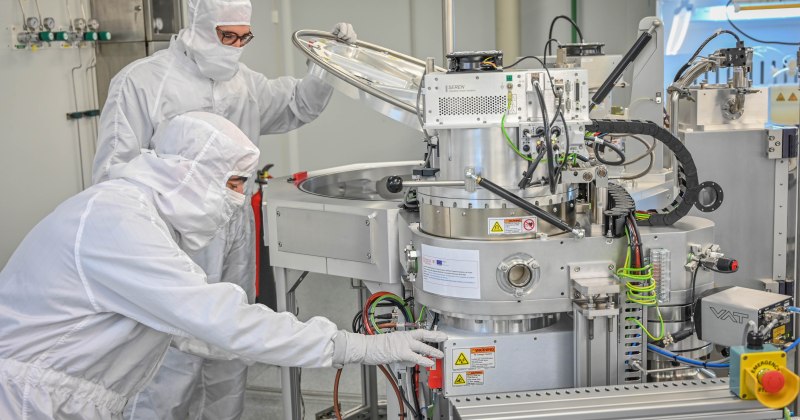
Crédito de la imagen: Elena Martínez Cuartero, Área de Comunicación de la Universitat Politècnica de València.

Biomaterials – expanding the scope

While regenerative medicine is going strong in biomaterials labs, in the last few years many seem to have moved a part of their vision to disease models. From making engineered tissues that promote healing inside the body, to making three dimensional in vitro models, as tools to study cellular interactions during disease.

In vitro models should work to understand all the different ways that cells interact with the extracellular matrix (ECM) and with other cells to allow disease to occur. With healthy tissues as a reference. The concept of in vitro model has also evolved quickly, from basic concepts that considered only one type of interaction to advanced models that start to bring in the complexity of cells – matrix interactions [1].

Cell change their behaviour and phenotype in response to signals such as matrix mechanical properties, matrix composition and degradation, the presence in the matrix of a variety of molecules, and more. To add to the complexity, the cell’s response and the signals received are very dynamic. 3D systems that only rely on the cells themselves, often result in dense, immature, and heterogeneous cell clusters with limited reproducibility and functionality. By creating biomaterial environments that mimic the ECM in different aspects at the same time, researchers can guide stem cell differentiation and the development of tissue structures such as organoids more effectively.

The first use of biomaterials in biomedical applications was as structural and inert support. Their current use has evolved to enhance functionalities of complex engineered systems [2], exploring their versatility as tunable platforms that provide instructive cues, which enhance cell fate transitions, tissue-level functions and reproducibility. New engineered 3D matrices and modular hydrogels create controlled environments. Biomaterials made from natural and synthetic polymers are being used to tune properties like stiffness and viscoelasticity, influencing cell signaling and tissue formation. For instance engineered matrices that mimic the key features (biochemical and mechanical) of a tumour such as pancreatic ductal adenocarcinoma, have just shown that its altered stiff ECM is the primary cause of chemoresistance [3], a characteristic feature of this lethal cancer.

References

[1] LeSavage, B.L., Suhar, R.A., Broguiere, N. et al. Next-generation cancer organoids. Nat. Mater. 21, 143–159 (2022). https://doi.org/10.1038/s41563-021-01057-5.

[2] Musah, S., Arzaghi, H. Unleashing the power of biomaterials to enhance organoid differentiation and function. Nat Methods 21, 1575–1577 (2024). https://doi.org/10.1038/s41592-024-02393-5.

[3] LeSavage, B.L., Zhang, D., Huerta-López, C. et al. Engineered matrices reveal stiffness-mediated chemoresistance in patient-derived pancreatic cancer organoids. Nat. Mater. 23, 1138–1149 (2024). https://doi.org/10.1038/s41563-024-01908-x

A long-term strategy to link research with impact opportunities.

In this post: upgrade the impact of your research by improving your connection with your local environment, with a long-term vision of building trust with knowledge-sharing communities or networks.

There are important changes underway (some notes about these changes at the end of the post) in the way universities organise themselves to produce impact, or in other words, to ensure that their knowledge production results in value for society.

Instead of one best model, there are a variety of models and structures that can work well for different universities, different departments, even researchers within the same university. We have realised that impact occurs at a variety of intersections [1]. Flexibility in the organisation of its activities, proactive support for a variety of impact cultures, facilitation of mixed communities, makes a knowledge-generating institution stronger when it comes to producing value.

With flexibility and different types of support structures available, real challenges and problems are more easily connected to possible solutions. More and better seed ideas are generated that feed into new research proposals.

This article is a discussion of what these changes in technology transfer (TT) support mean for the individual researcher and their lab, and how to take advantage of them.

The element of local interconnection. The largest structures and support programs for TT are created as top-down general programs, but changes are towards smaller specific structures. I share the opinion that there are more advantages in the decentralisation of support. Local singular connections are the most important, with great effects also at national and international levels. Most times an international collaboration comes from a local contact that connects also locally with the international partner. The search for local connections, in a proactive manner, can be the first practical tool to integrate structural changes in TT activity.

Building trust. In order to have a useful community, with which to work to generate impact, it is above all necessary to trust in the connections made. Successful knowledge exchange and impact actions invariably come from networks, especially local ones, in which trust is authentic. How is this culture of trust created in a community of people around a common purpose? How is this social capital created? By building complicity, listening a lot, putting oneself in the shoes of others as far as possible, with empathy and generosity. We can thus contribute to our colleagues, our closest contacts, feeling committed and inspired, or at least not contributing to generating demotivation and stress. In a research group, it is a good idea to have an environment of flexibility and academic freedom so that people can meet and be themselves and contribute to the group in different ways.

Share your vision and clarify expectations at different levels. With your colleagues, your bosses and the members of your laboratory, with your university services and your government institutions. Be prepared to be surprised and to change or qualify your opinion. Build a flexible community of contacts, with different priorities, varying institutional or individual identities, varying personalities and skills. By sharing your vision at various levels you will be able to improve the planning of ideas, project proposals and the state of your own lab and research activity.

Value quality rather than quantity in your production and that of other researchers. This is a change in the way of thinking about the planning of our TT activity. Not all activities or transferable results are equally important. It is a difficult change because it has only partially occur for the evaluation of research performance. However is critical for TT activities. While R&D evaluation catches up, lab PIs could create virtual spaces where the people they assess (students, other researchers) have creative opportunities where quality and excellence are prioritised over quantity, and results ready for TT have a chance to make it to market.

[1] Mark S. Reed and Ioan Fazey, Front. Sustain., 16 July 2021

Notes on institutional and structural changes in technology transfer.

There is a fundamental change underway in the way technology transfer is addressed by interested governments and institutions: universities and researchers are generators of knowledge but also intermediaries of that knowledge. The structures of interface with society in general, with companies in particular, work at a lower level than previously supported.

> In her keynote talk during the UPV Innovation day on the 1st of March 2023, Dr Alison Campbell (CEO of the new UK Government Office for Technology Transfer – GOTT) spoke of the recent change in trend in multinational companies, which now prefer to work with local contacts. In particular in the case of US companies. Dr Campbell also spoke about developments in the university spin-out creation environment, with the creation of new seed funds from central governments but also from universities themselves, and initiatives to involve students more closely in TT activities, given their growing interest in entrepreneurship and innovation. GOTT has published a government-level guide to knowledge asset management – The Rose Book. A summary of Dr Campbell’s talk is in this tweet by Carlos Ripoll.

> Universities are not the preferred partner for most companies in Spain when it comes to carrying out R&D activities [page 198 of the CYD Report on research and transfer in Spanish universities, March 2023]. With a slight increase in the percentage of innovative companies, Spain is still behind the EU average. It is very striking that in Spain companies have approximately 80% of their innovation activities in collaboration with other companies, while with universities and public research institutes they are at 15% of these activities [page 220 of the same CYD report].

> Why Spain is reindustrializing in the opposite way to Europe – article by Eugenio Mallol from February 2023 in ATLASTECH REVIEW, in which several recent reports and works on the balances between research, innovation and reindustrialization in EU countries and regions are discussed: «…even starting from similar initial structural conditions, regions can end up on different development paths, due, for example, to local innovative entrepreneurship, local institutional spirit and place-based leadership

> «It is urgent to promote the transfer of knowledge and, above all, to prioritize industrial research…» In this article by Xavier Ferrás, Diagnosis of R&D in Spain: insufficient progress after a lost decade, from January 2023, it is explained with data and comparing with other countries how in Spain «scientific policies have been made, but industrial policy aimed at creating economic fabric has been neglected.»

New trends in research

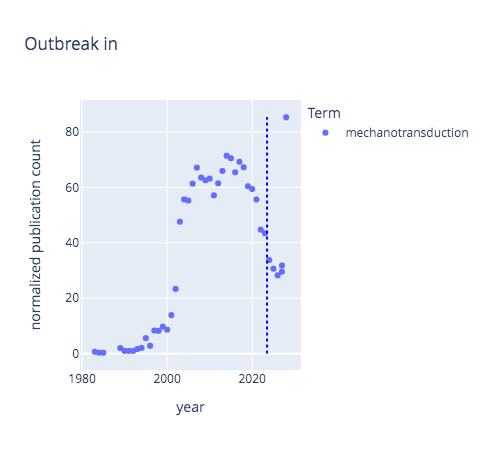
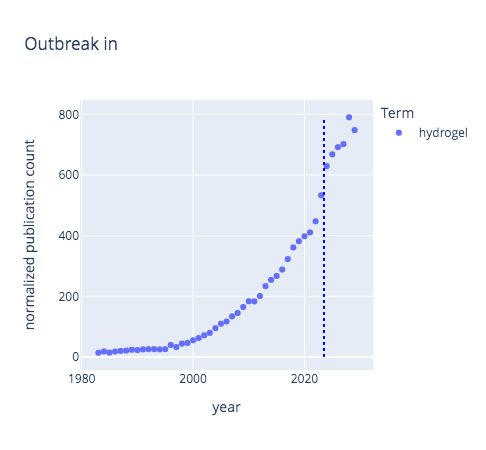
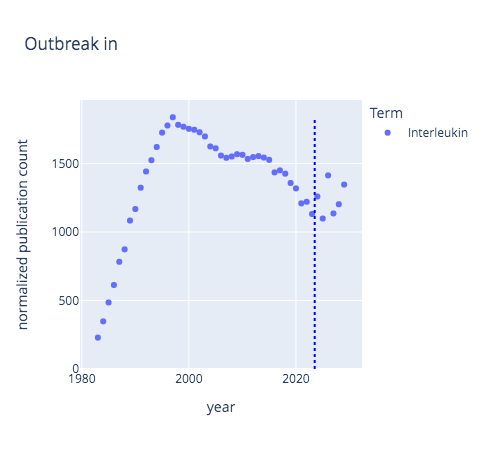
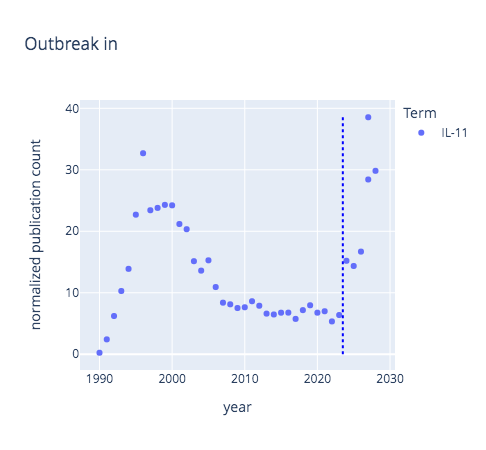
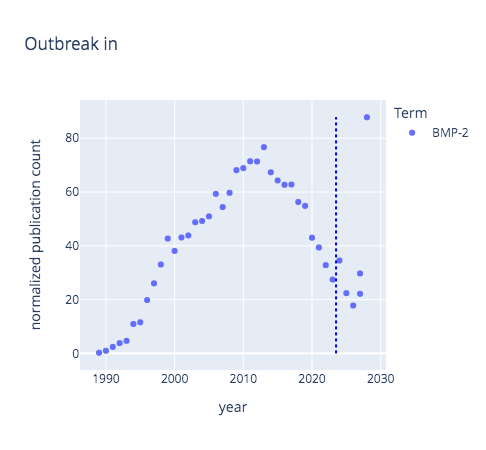
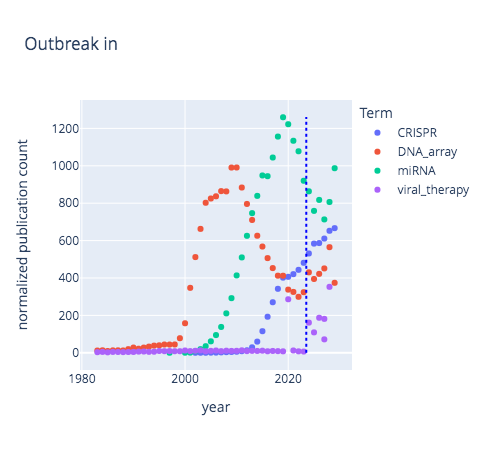
You can use your knowledge and intuition to predict the future, or you can use more or less elaborate methodologies, ideally you can fall back on the opinion of others with more of that knowledge and intuition. And now you can also use new AI tools or at least check what they have to say.

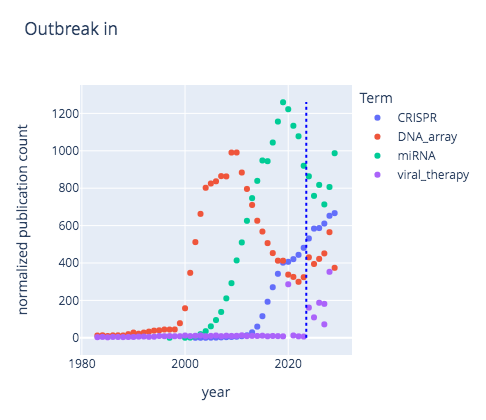
The linked paper is about predicting scientific research trends over time, and it presents a tool based on language models to do it. The model is trained with a number of indicators of popularity over the years, such as number of publications, reviews, patents, and others. It uses Pubmed so the topics are restricted to life sciences. In any case, it is always useful to keep an eye on research trends and forecasting opinions.

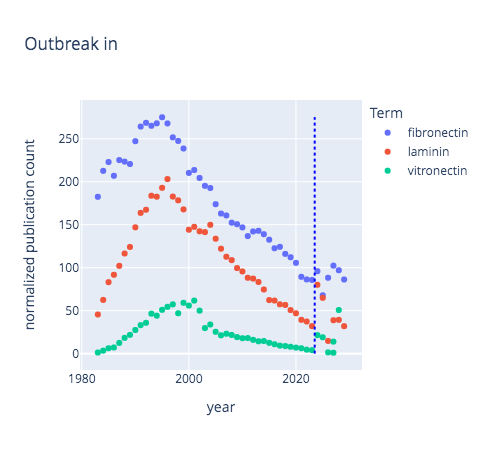
So I tried the AI tool and the results are overall difficult to trust, but interesting. Predictions appear to have strong anomalies in some cases. The tool seems to be good at extending trends that have been stable for the last few years, and misses trends that have had a serious change in the last year or couple of years. All pretty reasonable for now, and probably will be improved quickly with iterations of these AI models.

Still, the tool is useful to visualise information about current and past popularity of a topic, and how it compares to other topics. These below are examples of the plots the tool produces:

Thirty Years of Tissue Engineering

Innovation arises for many reasons. In this post I want to write about two ideas from a paper [1] published a few months ago, that discusses the past and future of tissue engineering, and how this ideas apply to Valencia and its innovation system. The paper is by Anthony Atala, a renowned figure in the field with significant contributions and impact on its development in the past decades.

Patient Enrollment in Clinical Trials. According to Atala, the number one challenge in getting products through the regulatory approval process is patient enrollment. Systems within corporations and health centers are often cumbersome, with a lack of coordinated efforts for ethical review boards, legal and financial expectations, and patient availability. We need programs that ease patient recruitment, from networks of hospitals, through a unified review process​​.

> I believe this applies very much to Valencia and its innovation system. We have a productive academic environment in the field and an excellent clinical network of hospitals. If more research results from our universities are to reach human clinical studies, then we need dedicated local or regional networks of hospitals with labs and units able to work with tissue engineering applications and simplify / unify the process. We could organise relationships to facilitate human trials in the field of tissue engineering. This is achievable for Valencia and its very good hospital and research networks.

Manufacturing technology from research results. This is the second major challenge according to Atala. Technologies (tissue-engineered products, bioprinting systems, microfluidics) have been and still are much more difficult to manufacture than initially thought. Most technologies have prolonged development timelines, high production and sale costs, and issues with end user adoption​​. For these technologies to reach a commercial phase there should be increased investment, coordinated manufacturing efforts ,and workforce development programs.

> This also applies to Valencia’s innovation system, although with a more challenging outlook. The manufacturing and investment environment in the region would have to increase strongly. We should update training programs at university level when needed, and support locally created jobs in the field. It might be difficult to achieve these goals. Many regions and nations attempt to achieve the same goals. Its complex and very influenced by external factors. We could follow the experience of other regions in Spain and other countries that started form similar conditions. We should implement proven, long-term strategies such as increasing investment in our industrial fabric and supporting manufacturing capabilities for tissue engineering products that reach clinical phases.

[1] Atala A. Thirty Years of Tissue Engineering. Tissue Eng Part A. 2024 Jan;30(1-2):5-13. doi: 10.1089/ten.TEA.2023.0322. PMID: 37950711.

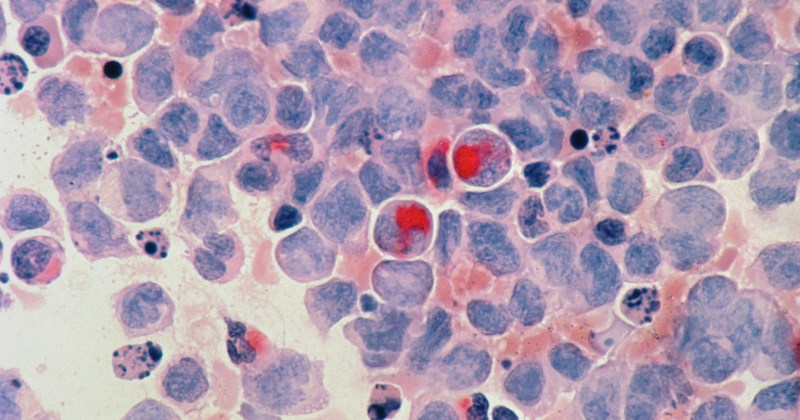
Image credit: CDC

How to pick a great scientific collaborator

My summary and notes from a column in Nature written by Danish Professor Carsten Lund Pedersen.

> Finding great collaborators and being able to work with them productively is one of the most important predictors of success.

> There are three main traits of a great partner: (i) they are «someone who is fun to work with«, (ii) they are «someone who contributes to the work«, and (iii) they are «someone who has the same ambition«

> From these three traits, Prof Pedersen proposes a tool or analysis framework that classifies collaborators and ourselves into:

  • «Most valuable collaborators», those who meet all three traits.
  • «Likeable freeloaders», those who are fun to work with and have the same level of ambition, but do not contribute significantly to the work. The author proposes that sometimes it is possible to redirect collaboration with a serious conversation.
  • «Annoying productives» are people who contribute to a project and share ambition, but are not fun to work with. They can help you progress, but they can also make you miserable in the process. The author proposes two options: avoid these individuals altogether, or «protect» yourself from them by having other, more fun collaborators on the same project.
  • «Misaligned partners» are fun to work with and contribute to the study, but do not have the same ambition. They do not work on the same topic or do not have similar career goals. The author proposes whether it is possible to find common projects in which the same level of ambition is shared.

The final and important proposal is to use the tool on ourselfs, as a self-assessment to understand how your collaborators see you, and to improve your interaction with them. The author uses the tool to describe that in the past his traits have sometimes been those of a «annoying productive» type partner, and being aware of this has made him change to a better collaborator profile.

Prof Pedersen conclusion about «how closely related is doing rigorous research with having fun in the process. So I try to make fun a priority in my projects» is very interesting. I think this can be a useful guidance for researchers for whom it is not easy to find long-lasting collaborations. A feature of many collaborative projects and interactions that could be improved is how enjoyable and fun they are for the participants. This makes us to put more or less energy into the collaboration, and ultimately to continue or not with it. Doing a critical self-analysis, recognising our defects, and setting out to improve, is a very brave and correct attitude.

Más asesoramiento regulatorio para la investigación biomédica

Es muy útil incorporar una perspectiva regulatoria lo antes posible en la actividad de investigación, pero no es nada habitual. En el campo biomédico es una información que puede ser decisiva para que un nuevo desarrollo tenga opciones de llegar a una aplicación clínica. Es decir, esta información puede ser útil en la planificación del desarrollo de una nueva tecnología médica, para anticipar un camino regulatorio aceptable, y un plan de trabajo que contenga métodos y estudios adecuados para obtener pruebas de seguridad y eficacia.

Es poco frecuente tener este tipo de información tan pronto. Normalmente se consulta con expertos regulatorios al final de la actividad de investigación académica, en una etapa de actividad de demostración o transferencia. Se consulta sobre los resultados de un trabajo de investigación después de años de trabajo, que pueden fácilmente estar equivocados en el sentido de llevar a una aplicación que no puede ser aprobada por el regulador o que tiene inconvenientes graves en la aplicación clínica imaginada a priori. El número de propuestas de proyectos de I+D biomédica básica o incluso de innovación que en su etapa creativa consideran una estrategia regulatoria es muy bajo.

En una charla reciente, un investigador biomédico reputado especializado en innovación, explicó un aspecto particular del éxito de su laboratorio, y del de Robert Langer con el que trabajó en su etapa de doctorado: una estructura informal de contactos de consultores regulatorios y expertos en patentes biomédicas. Esta red se usa de manera flexible para recoger información sobre el potencial de aplicación de ideas, desarrollos incipientes y propuestas en el laboratorio. La interacción con estos expertos puede guiar de manera determinante las decisiones de ingeniería y planificación del trabajo en etapas anteriores a realizar estudios preclínicos, presentar una patente, o colaborar con una empresa.

De manera simplificada, lo que podemos hacer con más impacto en nuestro laboratorio es incorporar consultas con expertos regulatorios ya en la actividad de investigación biomédica de TRL bajo. Podemos trabajar con ellos en una «hoja de ruta regulatoria» (regulatory roadmap en el argot inglés de este campo) o en alguna información más concreta de viabilidad o clasificación de las aplicaciones imaginadas. Para aprovechar estas consultas es conveniente preparar, además de una buena explicación de la ciencia que estamos desarrollando, (i) una reflexión sobre sus usos clínicos posibles, por ejemplo como nuevo medicamento administrado de manera oral o parenteral, como un material que hace de vehículo para liberar sustancias activas, etc.; (ii) las indicaciones previstas, las enfermedades y estados de la enfermedad para los que podría ser útil; (iii) los tipos o grupos de pacientes; (iv) los entornos de uso previstos, por ejemplo laboratorio de hospital, un quirófano, una residencia de ancianos, etc.; (v) los usuarios previstos y nivel de habilidad, por ejemplo médicos especialistas, pacientes capacitados, pacientes sin capacitación previa, etc.; (vi) el modo de acción: principios científicos que explican el resultado clínico previsto; y alguna característica más según cada caso.

La AEMPS y la EMA ofrecen también canales de consulta con sus expertos, como el Scientific Advice de la EMA, que se concreta en una lista de preguntas y que sirve para recoger opiniones no vinculantes sobre cómo generar información robusta de seguridad y eficacia de una medicina en desarrollo. Se puede solicitar en cualquier momento del desarrollo, pero mi experiencia es que no es fácil preparar preguntas adecuadas en etapas de I+D.

Después de la pérdida

Para cualquiera que se ve sano, con energía, es muy difícil imaginarse a uno mismo con una pérdida de salud grande. Menos aún en un futuro inmediato. Hay crisis vitales que nos afectan y nos cambian profundamente. Cuando ocurre, desde el principio hay una cierta sombra de negación, de no aceptación. Después, cuando empezamos a entender la nueva realidad, hay además una sensación de pérdida de cómo era nuestra vida anterior.

En mi caso he vivido este proceso directamente y también en segunda persona, como un caso clínico del que se puede tener información privilegiada. Escribo entonces este artículo sobre los ‘resultados’ de este estudio: Es muy interesante darse cuenta después de una pérdida de qué es lo que nos hace ser participantes activos de nuestra propia existencia, lo que nos impulsa en el día a día a convivir con el cambio de vida. Lo que ayuda a amortiguar los golpes de la vida. Puede ser cocinar para la familia, escribir ficción, leer novelas de aventuras, ver más a los amigos, etc. También para los que nos hemos recuperado, hay cosas que antes seguramente no se pensaban dos veces y que, después de acercarse al borde del acantilado, ahora están presentes de manera continua. Y es que el tratamiento de una enfermedad grave suele significar secuelas duraderas, para el resto de la vida. Las actividades del día a día se alteran radicalmente. Salir a comprar o a cenar, tener una conversación, estrechar una mano, coger un coche… casi todo lo que haces en los nuevos días, la nueva vida, está alterado de una manera clara. Enseguida te das cuenta que todo está sujeto a esta nueva condición.

Las palabras cáncer o tumor siguen siendo complicadas de pronunciar para muchos. Aunque el cáncer es un conjunto grande de enfermedades, algunas mortales con efectos devastadores y otras muchas tratables con bastante éxito, es de inicio una palabra aterradora. En muchos casos nos hace enfrentarnos a la posibilidad de morir, a dejar de existir y dejar sin nosotros a las personas que nos quieren. La dificultad de hablar del cáncer es parte de la dificultad social e individual de tratar el sufrimiento, la enfermedad, las partes sombrías de la vida, incluida la experiencia de morir, como parte de la vida.

La experiencia de sufrir tiene un lado positivo. Poco a poco uno se acostumbra a integrar lo que nos hace miserables como normal en un nuevo modo de vivir. Se hace normal hablar de ello. Y así, como aprendizaje, se aprende una manera de ayudar a otros con realidades parecidas. Ayudar con las necesidades del día a día, con aportaciones pequeñas y grandes que dan más oportunidades para disfrutar de cada día. Si quieres a esa persona, desde luego no quedarse solo en algunas palabras de ánimo. Proponer, si hace falta preguntando, cómo hacer la vida mejor para esta persona. Llevar a los niños a jugar con otros niños, traer unas croquetas caseras, organizar un picnic en la playa, ver una serie juntos, escuchar lo que tenga que decir y contar esta persona… cada persona tiene sus alegrías más o menos personales.

Después de la pérdida sabemos mejor cómo ayudar a otras personas que también han perdido. Y enseguida nos damos cuenta que en realidad esto vale para cualquier persona con la que nos relacionamos.

Crédito de la imagen: Juanma Pérez